Rust SDK Overview

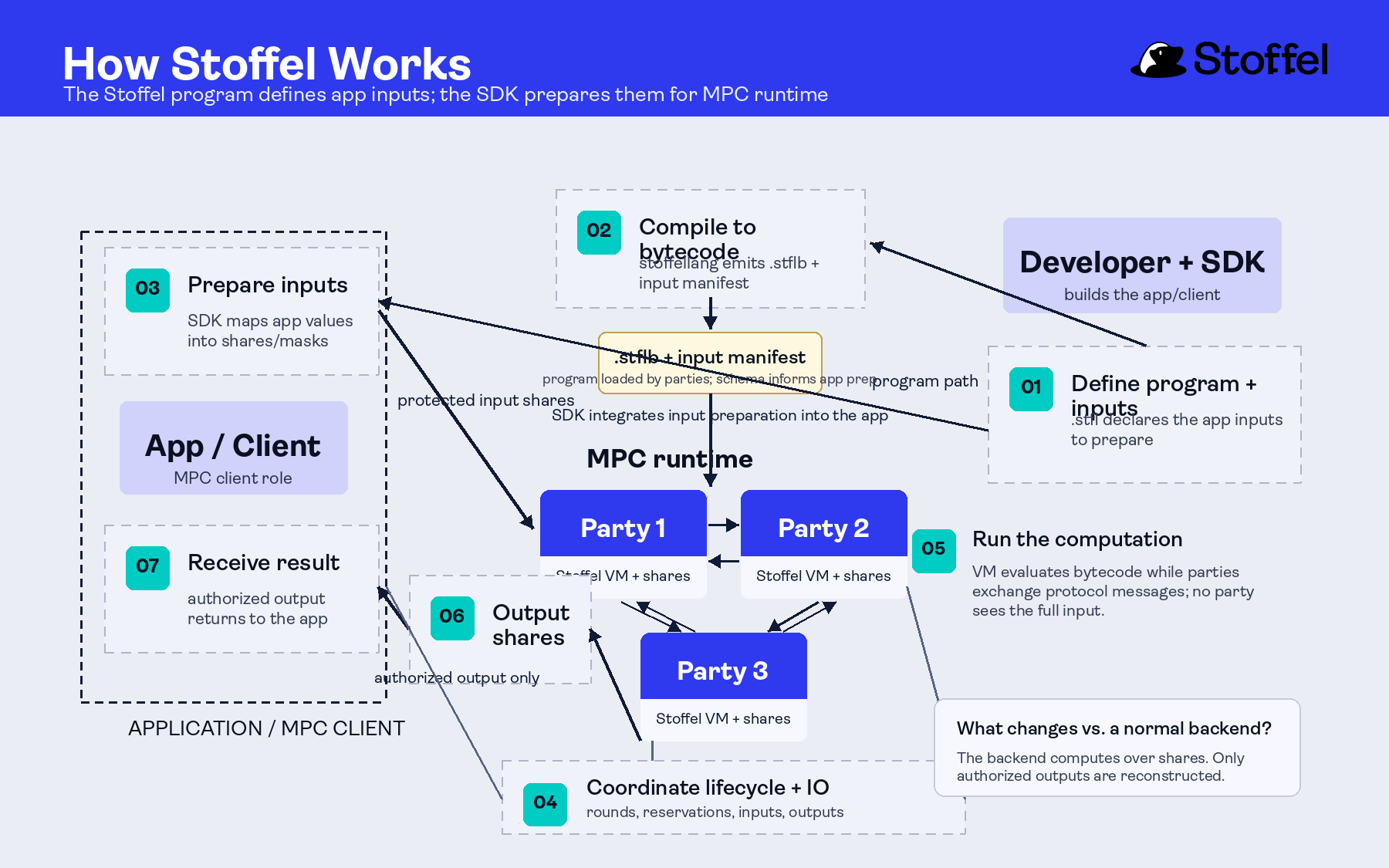
The Stoffel Rust SDK provides a high-level API for building Multi-Party Computation (MPC) applications in Rust. It bridges the StoffelLang compiler, StoffelVM execution engine, and HoneyBadger MPC protocol into a cohesive, developer-friendly interface.

Design Philosophy

The SDK is built around three core principles:

Progressive Disclosure

Three API levels for different needs:
  • Simple API: Quick compilation and local testing
  • Builder Pattern: Full MPC configuration
  • Advanced API: Direct access to network and protocol layers

MPC-First Design

Programs are configured for MPC during compilation, ensuring all participants use consistent parameters.

Clean Abstractions

The SDK hides cryptographic complexity while providing clear semantics for secret and public data.

MPCaaS Architecture

The SDK implements an MPC-as-a-Service (MPCaaS) architecture that separates app developers from infrastructure operators:
┌─────────────────────────────────────────────────────────────┐
│                     App Developers                          │
│  ┌──────────────────────────────────────────────────────┐   │
│  │              StoffelClient                            │   │
│  │  - Simple API: submit inputs, get outputs            │   │
│  │  - Auto-discovers network configuration              │   │
│  │  - No MPC knowledge required                         │   │
│  └──────────────────────────────────────────────────────┘   │
├─────────────────────────────────────────────────────────────┤
│                 Infrastructure Operators                     │
│  ┌──────────────────────────────────────────────────────┐   │
│  │              StoffelServer                            │   │
│  │  - Full mesh peer connections                        │   │
│  │  - HoneyBadger preprocessing                         │   │
│  │  - Handles secure computation                        │   │
│  └──────────────────────────────────────────────────────┘   │
└─────────────────────────────────────────────────────────────┘

StoffelClient (For App Developers)

use stoffel_rust_sdk::prelude::*;

async fn submit_computation() -> Result<i64> {
    // Connect to MPC network
    let client = StoffelClient::builder()
        .with_servers(&["mpc1.example.com:9000", "mpc2.example.com:9000"])
        .client_id(12345)
        .connect()
        .await?;

    // Submit inputs and get result
    let result = client.run(&[42, 100]).await?;

    Ok(result)
}

StoffelServer (For Infrastructure Operators)

use stoffel_rust_sdk::prelude::*;

async fn run_mpc_server(party_id: usize) -> Result<()> {
    // Load compiled program
    let program = Stoffel::compile_file("program.stfl")?.build()?;

    // Build and configure server
    let server = Stoffel::server(party_id)
        .bind("0.0.0.0:9000")
        .with_peers(&[
            (0, "peer0.example.com:9000"),
            (1, "peer1.example.com:9000"),
            (2, "peer2.example.com:9000"),
        ])
        .with_program(program.program().clone())
        .with_preprocessing(3, 8)  // triples, random shares
        .with_instance_id(12345)
        .build()?;

    // Start serving
    server.start().await?;
    server.connect_to_peers().await?;
    server.run_forever().await
}

QUIC Networking

All network communication uses QUIC for:
  • TLS 1.3 encryption: Secure by default
  • Stream multiplexing: Efficient message handling
  • Low latency: 0-RTT connection establishment
  • Connection migration: Handles network changes

Quick Start

Simple Local Execution

use stoffel_rust_sdk::prelude::*;

fn main() -> Result<()> {
    let source = r#"
        def add(a: int64, b: int64) -> int64:
            return a + b

        main main() -> int64:
            return add(10, 20)
    "#;

    let result = Stoffel::compile(source)?
        .execute_local()?;

    println!("Result: {:?}", result);
    Ok(())
}

MPC Configuration

use stoffel_rust_sdk::prelude::*;

fn main() -> Result<()> {
    let runtime = Stoffel::compile(source)?
        .parties(5)           // 5-party MPC network
        .threshold(1)         // Byzantine fault tolerance
        .instance_id(42)      // Unique computation ID
        .build()?;

    // Test locally before deployment
    let result = runtime.program().execute_local()?;
    println!("Local test result: {:?}", result);

    Ok(())
}

Creating MPC Participants

use stoffel_rust_sdk::prelude::*;

async fn setup_mpc() -> Result<()> {
    let runtime = Stoffel::compile(source)?
        .parties(5)
        .threshold(1)
        .build()?;

    // Create an MPC server (compute node)
    let server = runtime.server(0)
        .with_preprocessing(10, 25)  // 10 triples, 25 random shares
        .build()?;

    // Create an MPC client (input provider)
    let client = runtime.client(100)
        .with_inputs(vec![10, 20])
        .build()?;

    Ok(())
}

Core Components

Stoffel Builder

The entry point for all SDK operations:
Stoffel::compile(source)      // Compile from string
Stoffel::compile_file(path)   // Compile from file
Stoffel::load(bytecode)       // Load pre-compiled bytecode

StoffelRuntime

After building, provides access to:
let runtime = Stoffel::compile(source)?.build()?;

runtime.program()      // Access compiled bytecode
runtime.client(id)     // Create MPC client builder
runtime.server(id)     // Create MPC server builder
runtime.node(id)       // Create MPC node builder (client + server)

Program

Pure bytecode container with execution methods:
let program = runtime.program();

program.execute_local()?;                    // Run main function
program.execute_local_function("func")?;     // Run specific function
program.list_functions()?;                   // List available functions
program.save("output.stfb")?;                // Save bytecode to file

MPC Participants

Three participant types for different roles:
TypeProvides InputsComputesReceives Outputs
MPCClient
MPCServer
MPCNode

MPC Configuration

Protocol Parameters

Stoffel::compile(source)?
    .parties(5)                          // Number of parties (min: 4)
    .threshold(1)                        // Fault tolerance
    .instance_id(42)                     // Computation instance
    .protocol(ProtocolType::HoneyBadger) // MPC protocol
    .share_type(ShareType::Robust)       // Secret sharing scheme
    .build()?

Validation Rules

The SDK automatically validates MPC parameters:
  • HoneyBadger: Requires n >= 3t + 1 where n = parties, t = threshold
  • Minimum 4 parties with threshold 1
  • Common configurations:
    • 4 parties, threshold 1: 4 >= 4
    • 5 parties, threshold 1: 5 >= 4 ✓ (recommended default)
    • 7 parties, threshold 2: 7 >= 7

Error Handling

The SDK provides comprehensive error types:
use stoffel_rust_sdk::error::{Error, Result};

match Stoffel::compile(source)?.build() {
    Ok(runtime) => { /* success */ }
    Err(Error::CompilationError(msg)) => { /* syntax error */ }
    Err(Error::Configuration(msg)) => { /* invalid MPC params */ }
    Err(Error::Network(msg)) => { /* connection error */ }
    Err(e) => { /* other error */ }
}
Error categories:
  • CompilationError: StoffelLang syntax or semantic errors
  • RuntimeError: VM execution failures
  • MPCError: Protocol-level errors
  • Configuration: Invalid parameters
  • Network: Connection failures
  • IoError: File operations

Network Configuration

Programmatic Configuration

let runtime = Stoffel::compile(source)?
    .parties(5)
    .threshold(1)
    .build()?;

let server = runtime.server(0).build()?;
server.add_peer(1, "127.0.0.1:19201".parse()?);
server.bind_and_listen("127.0.0.1:19200".parse()?).await?;

TOML Configuration

# stoffel.toml
[network]
party_id = 0
bind_address = "127.0.0.1:9001"
bootstrap_address = "127.0.0.1:9000"
min_parties = 4

[mpc]
n_parties = 5
threshold = 1
instance_id = 12345
let runtime = Stoffel::compile(source)?
    .network_config_file("stoffel.toml")?
    .build()?;

Next Steps