

Overall System Design
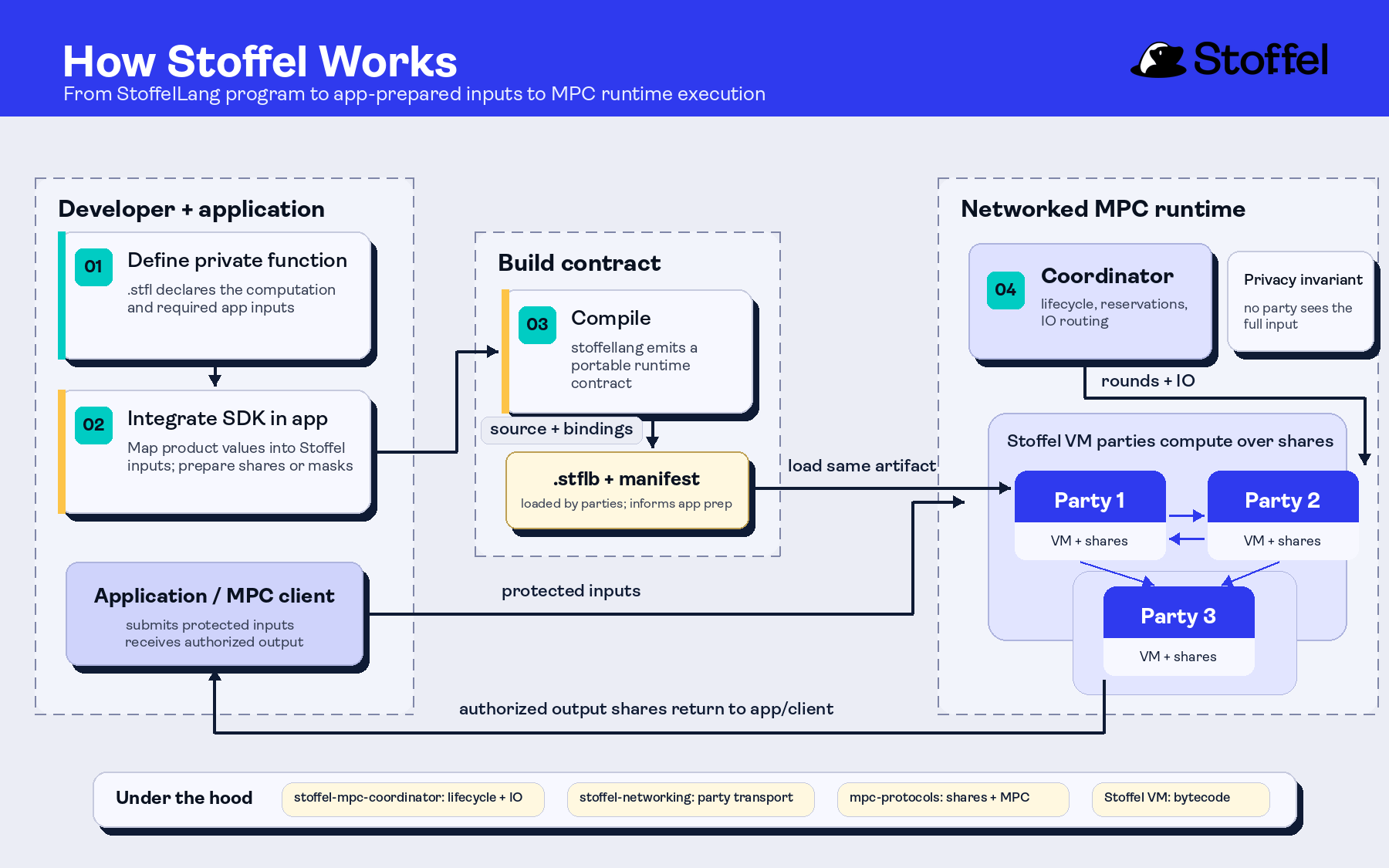
.stflb artifact connects the application-facing build path to the runtime party mesh. App code prepares protected inputs, the coordinator manages lifecycle and IO routing, and VM parties compute over shares.
Component Interactions
Development Workflow
- Project Creation: Stoffel CLI creates project structure with templates
- Code Writing: Developers write StoffelLang programs with MPC primitives
- Compilation: StoffelLang compiler generates optimized VM bytecode
- Testing: Local VM execution for development and testing
- Deployment: MPC network deployment with protocol integration
Runtime Execution
- Program Loading: Stoffel VM loads compiled bytecode
- Secret Sharing: Input data is secret-shared across MPC nodes
- Secure Computation: VM executes with MPC protocol integration
- Result Reconstruction: Output is reconstructed from secret shares
Data Flow
For the trust boundaries between the app, coordinator, and MPC parties, see the MPC Integration runtime diagram.Clear Data Path
- Public inputs and configuration data
- Direct VM register operations
- No cryptographic overhead
- Immediate availability across all nodes
Secret Data Path
- Private inputs requiring protection
- Automatic secret sharing on input
- MPC protocol operations during computation
- Selective reveal for output reconstruction
Security Architecture
Isolation Boundaries
- Process Isolation: Each MPC node runs in isolated environment
- Memory Protection: Clear and secret data separation
- Network Security: Deployments must authenticate party and client identities and protect confidential traffic
- Access Control: Role-based access to computation resources
Trust Model
- Backend-specific thresholds: HoneyBadgerMPC deployments require
n >= 4t+1; AVSS requiresn >= 3t+1 - Backend-specific adversaries: HoneyBadgerMPC targets a static active adversary. AVSS checks shares against public commitments, but its integrated multiplication path inherits a static passive preprocessing limitation unless triples are independently validated
- Conditional liveness: Asynchronous safety does not guarantee that every run or preprocessing attempt completes against every allowed fault
- Explicit output boundary: Inputs and intermediate values stay shared unless the program opens them or sends output shares to an authorized client
Scalability Design
Horizontal Scaling
- Committee Sizing: Select a backend-valid party count before execution; changing the committee requires an explicit secure resharing or transfer design
- Load Distribution: Computation workload balancing
- Geographic Distribution: Global node deployment support
Vertical Scaling
- Resource Optimization: Efficient CPU and memory usage
- Parallel Execution: Multi-threaded computation where possible
- Caching Strategies: Optimized data and computation caching
Integration Points
External Systems
- Database Integration: Secure querying of external databases
- API Integration: RESTful APIs for system interaction
- Blockchain Integration: Smart contract integration for verification
Development Tools
- IDE Support: Language server protocol integration
- Debugging Tools: Comprehensive debugging and profiling
- Testing Frameworks: Specialized testing for MPC applications