> ## Documentation Index
> Fetch the complete documentation index at: https://docs.stoffelmpc.com/llms.txt
> Use this file to discover all available pages before exploring further.
# Your First MPC Project
> Build and run a small secret-shared eligibility example with the Stoffel CLI and Rust SDK workflow.
This tutorial builds a small eligibility-score computation. The goal is to model one client value as a share, compute over that share, and reconstruct the derived score explicitly.
This is a small local example. Use the same modeling steps with your own deployment and security validation when moving beyond the tutorial.
 ## What you will use
* The `stoffel` CLI.
* The Rust SDK from crates.io when you run or adapt the Rust wrapper path.
* A `Share`-based StoffelLang program.
Finish [Installation](./installation) before starting.
## Create a project
```bash theme={null}
stoffel init eligibility-demo
cd eligibility-demo
```
Check the generated program first:
```bash theme={null}
stoffel check
stoffel build
stoffel run --program-info
```
## Replace `src/main.stfl`
Use this simple `Share`-based program:
```stoffel theme={null}
def normalize_score(raw_score: Share) -> Share:
var adjusted = raw_score.add_scalar(25)
return adjusted.mul_scalar(2)
def main() -> int64:
var private_score = ClientStore.take_share(0, 0)
var eligibility = normalize_score(private_score)
return eligibility.open()
```
The program keeps the input as a `Share` while it computes, then opens only the final eligibility score as the allowed tutorial output.
## Validate and build
```bash theme={null}
stoffel check
stoffel build
```
Inspect the bytecode if needed:
```bash theme={null}
stoffel compile --disassemble target/debug/eligibility-demo.stflb
```
If your project name produces a different bytecode file name, list `target/debug` and use that path.
## Run locally with a client input
Run the project through local MPC. This starts several MPC nodes/processes locally on your machine and feeds client slot `0` with the private input value:
```bash theme={null}
cd /path/to/eligibility-demo
stoffel run \
--client-input 0=42 \
--parties 5 \
--threshold 1
```
The returned value is `(42 + 25) * 2`, not the raw client input.
## Iterate in watch mode
```bash theme={null}
stoffel dev \
--client-input 0=42 \
--parties 5 \
--threshold 1
```
For scripts, add `--once`.
## Run the same idea from Rust
The Rust SDK is the primary application API for embedding Stoffel programs in Rust apps. Use the bytecode you already built from `src/main.stfl` instead of embedding a second sample program in Rust. In this example, `.execute_local().await?` performs local MPC testing by spawning several MPC nodes/processes on your machine:
```rust theme={null}
use stoffel::prelude::*;
#[tokio::main]
async fn main() -> stoffel::Result<()> {
let result = Stoffel::load_file("target/debug/eligibility-demo.stflb")?
.parties(5)
.threshold(1)
.with_client_input(0, &[42_i64])
.execute_local()
.await?;
println!("Result: {}", result[0]);
Ok(())
}
```
## Shape it like an app integration
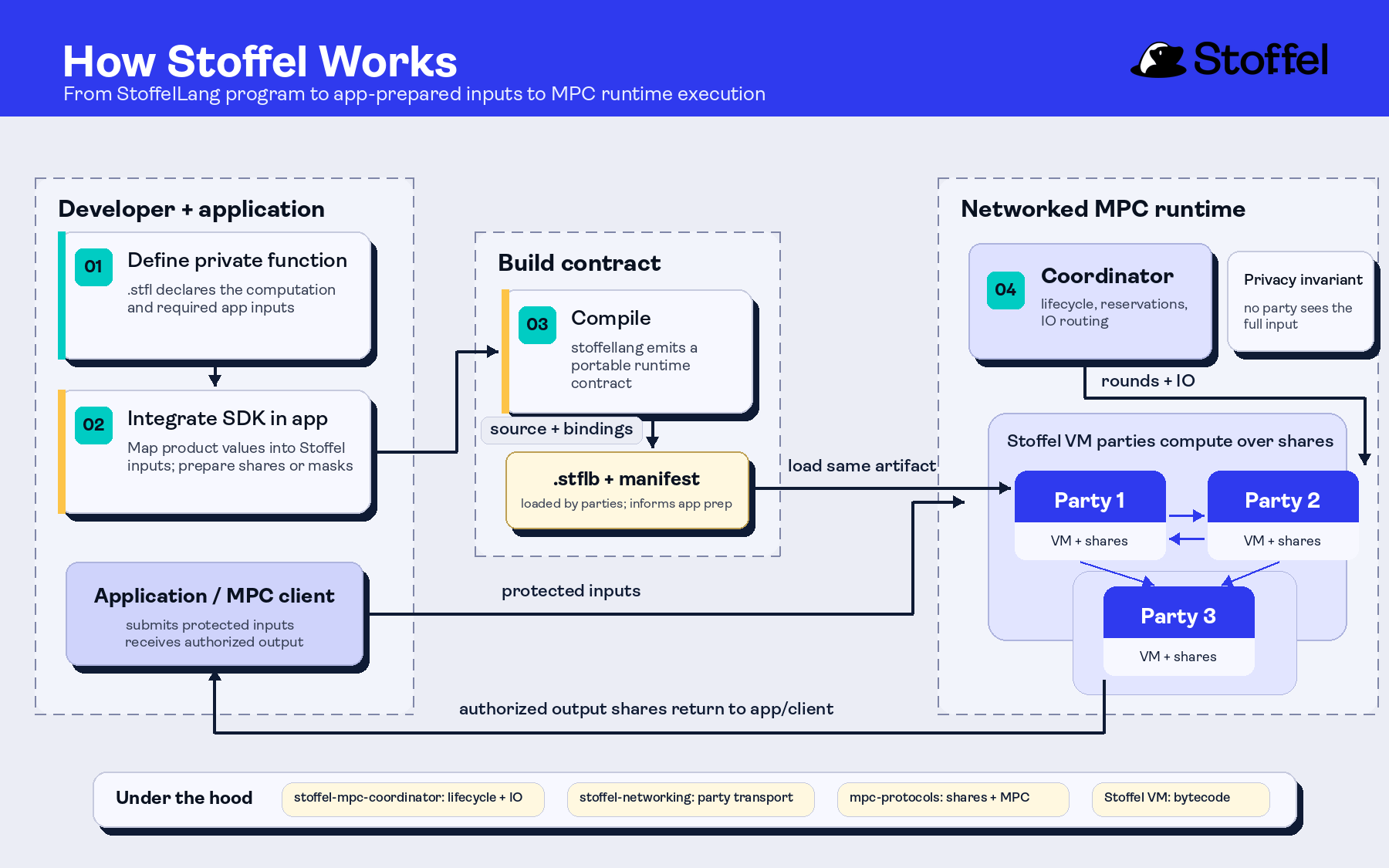
A larger app usually separates the code that owns the MPC network from the code that handles user/client requests. MPC nodes run away from input and output clients; the client-facing app identifies the private portion of a request and hands that portion to the Stoffel-backed workflow.
For this tutorial, keep everything on your development machine but split the project like an app would be split:
```text theme={null}
src/
├── app.rs # ordinary app types and non-private decision logic
├── client.rs # client/request handling boundary
├── lib.rs # shared module exports
├── main.stfl # private MPC program
└── bin/
├── local_mpc.rs # initializes the Stoffel program and local MPC loop
└── eligibility_client.rs # command-line client handler
```
Create `src/lib.rs`:
```rust theme={null}
pub mod app;
pub mod client;
```
Create `src/app.rs` for the ordinary application types:
```rust theme={null}
#[derive(Debug, Clone)]
pub struct EligibilityRequest {
pub account_id: String,
pub private_score: i64,
pub public_region: String,
}
#[derive(Debug, Clone)]
pub struct EligibilityDecision {
pub account_id: String,
pub public_region: String,
pub eligibility_score: i64,
pub approved: bool,
}
pub fn decision_from_score(
request: EligibilityRequest,
eligibility_score: i64,
) -> EligibilityDecision {
EligibilityDecision {
account_id: request.account_id,
public_region: request.public_region,
eligibility_score,
approved: eligibility_score >= 100,
}
}
```
Create `src/bin/main.rs`. This is the local development network owner: it loads the bytecode built from `src/main.stfl`, waits for client requests, and runs each private score through local MPC. Stop it with `Ctrl-C` when you are done.
```rust theme={null}
use std::{fs, path::Path, time::Duration};
use stoffel::prelude::*;
use tokio::time::sleep;
const WORK_DIR: &str = "target/dev-mpc";
const REQUEST_FILE: &str = "target/dev-mpc/request.txt";
const RESPONSE_FILE: &str = "target/dev-mpc/response.txt";
#[tokio::main]
async fn main() -> stoffel::Result<()> {
fs::create_dir_all(WORK_DIR)?;
let runtime = Stoffel::load_file("target/debug/eligibility-demo.stflb")?
.parties(5)
.threshold(1)
.build()?;
println!("Local MPC process ready. Waiting for requests in {REQUEST_FILE}.");
let mut last_request = String::new();
loop {
if Path::new(REQUEST_FILE).exists() {
let request = fs::read_to_string(REQUEST_FILE)?;
if request != last_request {
last_request = request.clone();
let private_score: i64 = request.trim().parse().map_err(|error| {
Error::InvalidInput(format!("invalid private score: {error}"))
})?;
let result = runtime
.clone()
.with_client_input(0, &[private_score])
.execute_local()
.await?;
let eligibility_score = result[0]
.as_i64()
.ok_or_else(|| Error::InvalidInput("expected int64 eligibility score".into()))?;
fs::write(RESPONSE_FILE, eligibility_score.to_string())?;
println!("Handled private score for client slot 0.");
}
}
sleep(Duration::from_millis(250)).await;
}
}
```
Create `src/client.rs`. This file is the client-handling boundary: it accepts an application request, sends only the private score to the local MPC side, then combines the returned score with ordinary app fields.
```rust theme={null}
use std::{fs, path::Path, thread, time::Duration};
use stoffel::prelude::*;
use crate::app::{decision_from_score, EligibilityDecision, EligibilityRequest};
const WORK_DIR: &str = "target/dev-mpc";
const REQUEST_FILE: &str = "target/dev-mpc/request.txt";
const RESPONSE_FILE: &str = "target/dev-mpc/response.txt";
pub fn handle_eligibility_request(
request: EligibilityRequest,
) -> stoffel::Result {
fs::create_dir_all(WORK_DIR)?;
if Path::new(RESPONSE_FILE).exists() {
fs::remove_file(RESPONSE_FILE)?;
}
fs::write(REQUEST_FILE, request.private_score.to_string())?;
let eligibility_score = loop {
if Path::new(RESPONSE_FILE).exists() {
let raw = fs::read_to_string(RESPONSE_FILE)?;
break raw.trim().parse::().map_err(|error| {
Error::InvalidInput(format!("invalid eligibility score: {error}"))
})?;
}
thread::sleep(Duration::from_millis(250));
};
Ok(decision_from_score(request, eligibility_score))
}
```
Create `src/bin/eligibility_client.rs` as a command-line entry point for the client-handling code:
```rust theme={null}
use eligibility_demo::app::EligibilityRequest;
use eligibility_demo::client::handle_eligibility_request;
fn main() -> stoffel::Result<()> {
let mut args = std::env::args().skip(1);
let account_id = args.next().unwrap_or_else(|| "acct_123".to_owned());
let private_score = args
.next()
.as_deref()
.unwrap_or("42")
.parse::()
.map_err(|error| stoffel::Error::InvalidInput(format!("invalid score: {error}")))?;
let public_region = args.next().unwrap_or_else(|| "ca".to_owned());
let decision = handle_eligibility_request(EligibilityRequest {
account_id,
private_score,
public_region,
})?;
println!("{decision:?}");
Ok(())
}
```
Run the local MPC owner in one terminal:
```bash theme={null}
cargo run --bin main
```
Then run the client handler from another terminal:
```bash theme={null}
cargo run --bin eligibility_client -- acct_123 42 ca
```
The important separation is that ordinary app logic stays in Rust, client handling lives in its own module, and the Stoffel program owns the private computation. In this local tutorial, `main.rs` starts local MPC nodes on the same development machine. In a deployed setup, that network would run elsewhere, and the client-handling side would connect to it instead of using this local file-based handoff.
Want to deploy MPC apps instead of running local development networks? [Sign up for Stoffel updates](https://buttondown.com/stoffel) to hear when we launch the platform for deploying MPC apps.
## Design notes
* Identify which input is secret-shared, which policy logic is public, and which computed result should be reconstructed.
* Keep sensitive values as `Share` values while computing.
* Use `open()` only for outputs you intentionally reveal.
* For client-directed share outputs beyond this tutorial, prefer `MpcOutput.send_to_client` or `Share.send_to_client`.
* Use `stoffel check --print-ir`, `stoffel run --program-info`, and bytecode disassembly when debugging.
## Next steps
* [Basic Usage](./basic-usage)
* [StoffelLang Overview](../stoffel-lang/overview)
* [Rust SDK Examples](../rust-sdk/examples)
## What you will use
* The `stoffel` CLI.
* The Rust SDK from crates.io when you run or adapt the Rust wrapper path.
* A `Share`-based StoffelLang program.
Finish [Installation](./installation) before starting.
## Create a project
```bash theme={null}
stoffel init eligibility-demo
cd eligibility-demo
```
Check the generated program first:
```bash theme={null}
stoffel check
stoffel build
stoffel run --program-info
```
## Replace `src/main.stfl`
Use this simple `Share`-based program:
```stoffel theme={null}
def normalize_score(raw_score: Share) -> Share:
var adjusted = raw_score.add_scalar(25)
return adjusted.mul_scalar(2)
def main() -> int64:
var private_score = ClientStore.take_share(0, 0)
var eligibility = normalize_score(private_score)
return eligibility.open()
```
The program keeps the input as a `Share` while it computes, then opens only the final eligibility score as the allowed tutorial output.
## Validate and build
```bash theme={null}
stoffel check
stoffel build
```
Inspect the bytecode if needed:
```bash theme={null}
stoffel compile --disassemble target/debug/eligibility-demo.stflb
```
If your project name produces a different bytecode file name, list `target/debug` and use that path.
## Run locally with a client input
Run the project through local MPC. This starts several MPC nodes/processes locally on your machine and feeds client slot `0` with the private input value:
```bash theme={null}
cd /path/to/eligibility-demo
stoffel run \
--client-input 0=42 \
--parties 5 \
--threshold 1
```
The returned value is `(42 + 25) * 2`, not the raw client input.
## Iterate in watch mode
```bash theme={null}
stoffel dev \
--client-input 0=42 \
--parties 5 \
--threshold 1
```
For scripts, add `--once`.
## Run the same idea from Rust
The Rust SDK is the primary application API for embedding Stoffel programs in Rust apps. Use the bytecode you already built from `src/main.stfl` instead of embedding a second sample program in Rust. In this example, `.execute_local().await?` performs local MPC testing by spawning several MPC nodes/processes on your machine:
```rust theme={null}
use stoffel::prelude::*;
#[tokio::main]
async fn main() -> stoffel::Result<()> {
let result = Stoffel::load_file("target/debug/eligibility-demo.stflb")?
.parties(5)
.threshold(1)
.with_client_input(0, &[42_i64])
.execute_local()
.await?;
println!("Result: {}", result[0]);
Ok(())
}
```
## Shape it like an app integration
A larger app usually separates the code that owns the MPC network from the code that handles user/client requests. MPC nodes run away from input and output clients; the client-facing app identifies the private portion of a request and hands that portion to the Stoffel-backed workflow.
For this tutorial, keep everything on your development machine but split the project like an app would be split:
```text theme={null}
src/
├── app.rs # ordinary app types and non-private decision logic
├── client.rs # client/request handling boundary
├── lib.rs # shared module exports
├── main.stfl # private MPC program
└── bin/
├── local_mpc.rs # initializes the Stoffel program and local MPC loop
└── eligibility_client.rs # command-line client handler
```
Create `src/lib.rs`:
```rust theme={null}
pub mod app;
pub mod client;
```
Create `src/app.rs` for the ordinary application types:
```rust theme={null}
#[derive(Debug, Clone)]
pub struct EligibilityRequest {
pub account_id: String,
pub private_score: i64,
pub public_region: String,
}
#[derive(Debug, Clone)]
pub struct EligibilityDecision {
pub account_id: String,
pub public_region: String,
pub eligibility_score: i64,
pub approved: bool,
}
pub fn decision_from_score(
request: EligibilityRequest,
eligibility_score: i64,
) -> EligibilityDecision {
EligibilityDecision {
account_id: request.account_id,
public_region: request.public_region,
eligibility_score,
approved: eligibility_score >= 100,
}
}
```
Create `src/bin/main.rs`. This is the local development network owner: it loads the bytecode built from `src/main.stfl`, waits for client requests, and runs each private score through local MPC. Stop it with `Ctrl-C` when you are done.
```rust theme={null}
use std::{fs, path::Path, time::Duration};
use stoffel::prelude::*;
use tokio::time::sleep;
const WORK_DIR: &str = "target/dev-mpc";
const REQUEST_FILE: &str = "target/dev-mpc/request.txt";
const RESPONSE_FILE: &str = "target/dev-mpc/response.txt";
#[tokio::main]
async fn main() -> stoffel::Result<()> {
fs::create_dir_all(WORK_DIR)?;
let runtime = Stoffel::load_file("target/debug/eligibility-demo.stflb")?
.parties(5)
.threshold(1)
.build()?;
println!("Local MPC process ready. Waiting for requests in {REQUEST_FILE}.");
let mut last_request = String::new();
loop {
if Path::new(REQUEST_FILE).exists() {
let request = fs::read_to_string(REQUEST_FILE)?;
if request != last_request {
last_request = request.clone();
let private_score: i64 = request.trim().parse().map_err(|error| {
Error::InvalidInput(format!("invalid private score: {error}"))
})?;
let result = runtime
.clone()
.with_client_input(0, &[private_score])
.execute_local()
.await?;
let eligibility_score = result[0]
.as_i64()
.ok_or_else(|| Error::InvalidInput("expected int64 eligibility score".into()))?;
fs::write(RESPONSE_FILE, eligibility_score.to_string())?;
println!("Handled private score for client slot 0.");
}
}
sleep(Duration::from_millis(250)).await;
}
}
```
Create `src/client.rs`. This file is the client-handling boundary: it accepts an application request, sends only the private score to the local MPC side, then combines the returned score with ordinary app fields.
```rust theme={null}
use std::{fs, path::Path, thread, time::Duration};
use stoffel::prelude::*;
use crate::app::{decision_from_score, EligibilityDecision, EligibilityRequest};
const WORK_DIR: &str = "target/dev-mpc";
const REQUEST_FILE: &str = "target/dev-mpc/request.txt";
const RESPONSE_FILE: &str = "target/dev-mpc/response.txt";
pub fn handle_eligibility_request(
request: EligibilityRequest,
) -> stoffel::Result {
fs::create_dir_all(WORK_DIR)?;
if Path::new(RESPONSE_FILE).exists() {
fs::remove_file(RESPONSE_FILE)?;
}
fs::write(REQUEST_FILE, request.private_score.to_string())?;
let eligibility_score = loop {
if Path::new(RESPONSE_FILE).exists() {
let raw = fs::read_to_string(RESPONSE_FILE)?;
break raw.trim().parse::().map_err(|error| {
Error::InvalidInput(format!("invalid eligibility score: {error}"))
})?;
}
thread::sleep(Duration::from_millis(250));
};
Ok(decision_from_score(request, eligibility_score))
}
```
Create `src/bin/eligibility_client.rs` as a command-line entry point for the client-handling code:
```rust theme={null}
use eligibility_demo::app::EligibilityRequest;
use eligibility_demo::client::handle_eligibility_request;
fn main() -> stoffel::Result<()> {
let mut args = std::env::args().skip(1);
let account_id = args.next().unwrap_or_else(|| "acct_123".to_owned());
let private_score = args
.next()
.as_deref()
.unwrap_or("42")
.parse::()
.map_err(|error| stoffel::Error::InvalidInput(format!("invalid score: {error}")))?;
let public_region = args.next().unwrap_or_else(|| "ca".to_owned());
let decision = handle_eligibility_request(EligibilityRequest {
account_id,
private_score,
public_region,
})?;
println!("{decision:?}");
Ok(())
}
```
Run the local MPC owner in one terminal:
```bash theme={null}
cargo run --bin main
```
Then run the client handler from another terminal:
```bash theme={null}
cargo run --bin eligibility_client -- acct_123 42 ca
```
The important separation is that ordinary app logic stays in Rust, client handling lives in its own module, and the Stoffel program owns the private computation. In this local tutorial, `main.rs` starts local MPC nodes on the same development machine. In a deployed setup, that network would run elsewhere, and the client-handling side would connect to it instead of using this local file-based handoff.
Want to deploy MPC apps instead of running local development networks? [Sign up for Stoffel updates](https://buttondown.com/stoffel) to hear when we launch the platform for deploying MPC apps.
## Design notes
* Identify which input is secret-shared, which policy logic is public, and which computed result should be reconstructed.
* Keep sensitive values as `Share` values while computing.
* Use `open()` only for outputs you intentionally reveal.
* For client-directed share outputs beyond this tutorial, prefer `MpcOutput.send_to_client` or `Share.send_to_client`.
* Use `stoffel check --print-ir`, `stoffel run --program-info`, and bytecode disassembly when debugging.
## Next steps
* [Basic Usage](./basic-usage)
* [StoffelLang Overview](../stoffel-lang/overview)
* [Rust SDK Examples](../rust-sdk/examples)