> ## Documentation Index
> Fetch the complete documentation index at: https://docs.stoffelmpc.com/llms.txt
> Use this file to discover all available pages before exploring further.
# MPC Integration
> How Stoffel integrates with MPC backends, secret sharing, client inputs, and backend-specific security models.
Use this page to understand how private client inputs move through Stoffel: input collection, secret sharing, VM execution, openings, and client-output delivery. If you are deciding which backend to use, start with [MPC Backends](../mpc-protocols/overview). If you already chose a backend and need config or runtime details, use [How Backend Selection Works](../mpc-protocols/implementation).

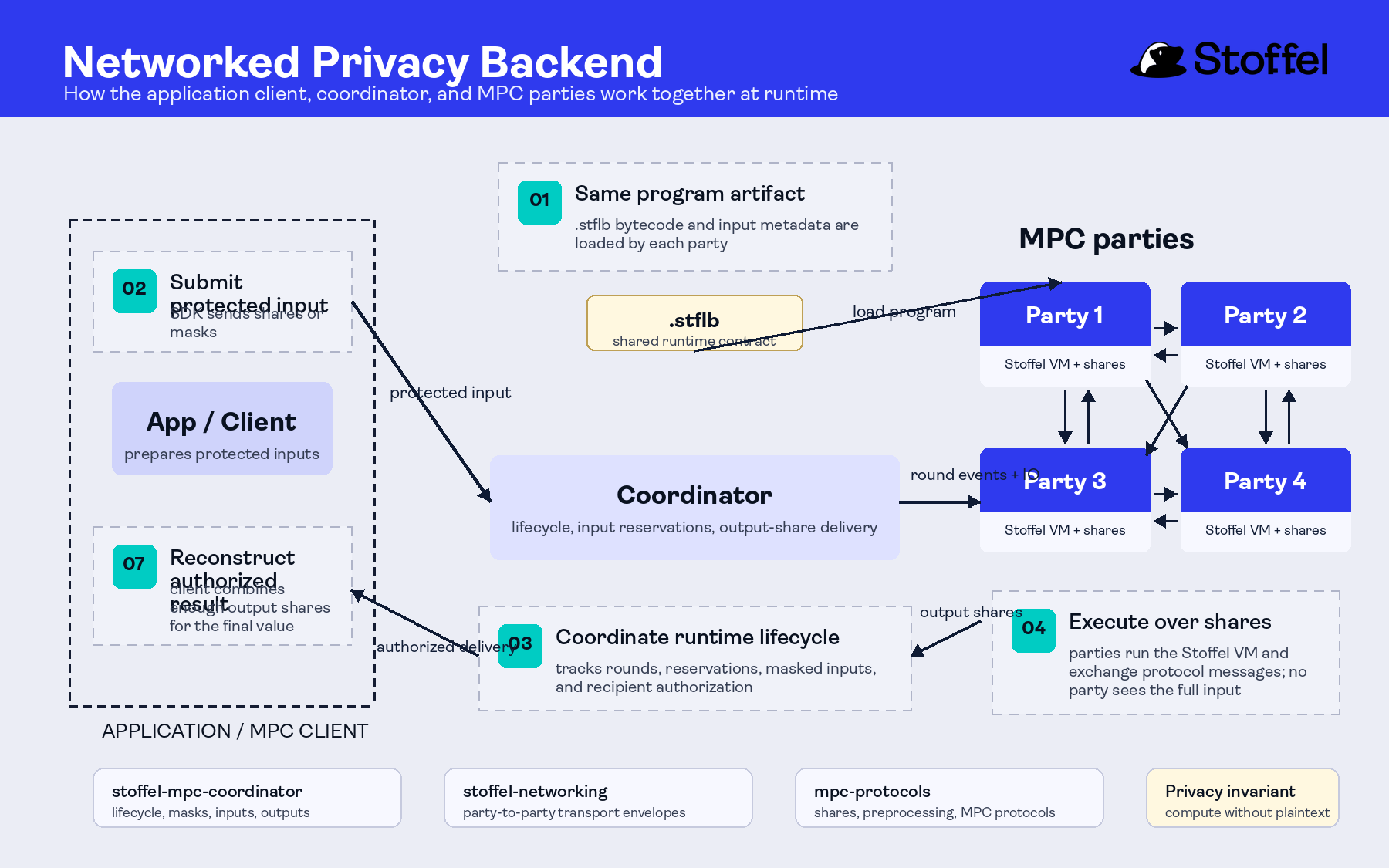 ## Protocol Architecture
## Protocol architecture
```text theme={null}
StoffelLang program
│
▼
Compiled bytecode manifest
│
├── backend: HoneyBadgerMPC | AVSS
├── curve/field metadata
├── client input/output schema
└── preprocessing demand
│
▼
VM + selected MPC backend
```
## Current backend support
| Backend | Purpose | Developer selector |
| -------------- | -------------------------------------------------------------------------------------------- | ----------------------------------------------------- |
| HoneyBadgerMPC | Default asynchronous/robust backend for field-compatible secret application values. | `honeybadger` / `MpcBackend::HoneyBadger` |
| AVSS | AVSS backend for verifiable scalar shares, public commitments, and curve-compatible outputs. | `avss`, `avss:` / `MpcBackend::Avss { curve }` |
Both backends use the same high-level Stoffel application model, but they are not interchangeable at the cryptographic layer. HoneyBadgerMPC is field-arithmetic oriented. AVSS is group/scalar oriented and is the backend to use when the output boundary needs public commitments, curve-encoded values, or scalar responses that match an external verifier.
## Integration points
### Stoffel VM
* Secret register operations map to backend share operations.
* Clear-to-secret transitions create backend share data.
* Reveal/open operations reconstruct values through the selected backend.
* `Share.random`, `Share.open`, `Share.get_commitment`, and `Mpc.*` builtins route through backend capabilities.
### CLI and bytecode
* `Stoffel.toml` stores `[mpc] backend`, optional `curve`, `parties`, and `threshold`.
* CLI flags such as `--backend`, `--field`, `--parties`, and `--threshold` override project settings.
* `.stflb` bytecode records backend and curve/field metadata so execution can validate the runtime configuration.
### Rust SDK
* `MpcConfig::builder()` configures parties, threshold, instance ID, and backend.
* Program builders accept `.backend(...)` and `.curve(...)`.
* `NetworkDeployment` and off-chain client configs carry backend selection into generated network/client TOML.
## Security model
Each backend has its own threat model and assumptions. Do not treat “MPC backend” as a single security claim.
| Backend | Security posture |
| -------------- | --------------------------------------------------------------------------------------------------------------------------------------------------------------------------------------------------- |
| HoneyBadgerMPC | Asynchronous, Byzantine-robust, field-based MPC for private computation over application values. Use it when the output boundary is an opened result or client-output shares. |
| AVSS | Asynchronous verifiable secret sharing with Feldman-style commitments. Use it when public commitments, curve-encoded values, or scalar responses are part of the verifier-facing protocol boundary. |
Current Stoffel local/network config validates:
```text theme={null}
parties >= 4 * threshold + 1
```
Use five parties and threshold one for local development unless you are intentionally testing a larger topology.
## Data protection flow
* Inputs become secret shares through ClientStore or direct secret-value paths.
* Computation proceeds over backend share data.
* Intermediate secret values remain secret unless the program opens/reveals them.
* Outputs are returned, opened, or sent to client slots only where the program explicitly does so.
## Performance considerations
| Operation shape | Notes |
| ------------------------------- | ------------------------------------------------------------------------------------------------------------- |
| Local share arithmetic | Addition, subtraction, and scalar operations are usually cheap. |
| Secret multiplication | Requires backend protocol work and preprocessing. |
| Opening/reveal | Requires reconstruction from enough parties. |
| Comparisons and bit-heavy logic | More expensive than field arithmetic because they lower into additional share operations. |
| Curve/commitment workflows | Use AVSS when the output boundary needs public commitments, curve-encoded values, or opened scalar responses. |
## See also
* [MPC Protocols](../mpc-protocols/overview)
* [How Backend Selection Works](../mpc-protocols/implementation)
* [HoneyBadgerMPC](../mpc-protocols/honeybadger-mpc)
* [AVSS](../mpc-protocols/avss)
* [Stoffel VM Overview](../stoffel-vm/overview)
* [Rust SDK API](../rust-sdk/api)
## Protocol Architecture
## Protocol architecture
```text theme={null}
StoffelLang program
│
▼
Compiled bytecode manifest
│
├── backend: HoneyBadgerMPC | AVSS
├── curve/field metadata
├── client input/output schema
└── preprocessing demand
│
▼
VM + selected MPC backend
```
## Current backend support
| Backend | Purpose | Developer selector |
| -------------- | -------------------------------------------------------------------------------------------- | ----------------------------------------------------- |
| HoneyBadgerMPC | Default asynchronous/robust backend for field-compatible secret application values. | `honeybadger` / `MpcBackend::HoneyBadger` |
| AVSS | AVSS backend for verifiable scalar shares, public commitments, and curve-compatible outputs. | `avss`, `avss:` / `MpcBackend::Avss { curve }` |
Both backends use the same high-level Stoffel application model, but they are not interchangeable at the cryptographic layer. HoneyBadgerMPC is field-arithmetic oriented. AVSS is group/scalar oriented and is the backend to use when the output boundary needs public commitments, curve-encoded values, or scalar responses that match an external verifier.
## Integration points
### Stoffel VM
* Secret register operations map to backend share operations.
* Clear-to-secret transitions create backend share data.
* Reveal/open operations reconstruct values through the selected backend.
* `Share.random`, `Share.open`, `Share.get_commitment`, and `Mpc.*` builtins route through backend capabilities.
### CLI and bytecode
* `Stoffel.toml` stores `[mpc] backend`, optional `curve`, `parties`, and `threshold`.
* CLI flags such as `--backend`, `--field`, `--parties`, and `--threshold` override project settings.
* `.stflb` bytecode records backend and curve/field metadata so execution can validate the runtime configuration.
### Rust SDK
* `MpcConfig::builder()` configures parties, threshold, instance ID, and backend.
* Program builders accept `.backend(...)` and `.curve(...)`.
* `NetworkDeployment` and off-chain client configs carry backend selection into generated network/client TOML.
## Security model
Each backend has its own threat model and assumptions. Do not treat “MPC backend” as a single security claim.
| Backend | Security posture |
| -------------- | --------------------------------------------------------------------------------------------------------------------------------------------------------------------------------------------------- |
| HoneyBadgerMPC | Asynchronous, Byzantine-robust, field-based MPC for private computation over application values. Use it when the output boundary is an opened result or client-output shares. |
| AVSS | Asynchronous verifiable secret sharing with Feldman-style commitments. Use it when public commitments, curve-encoded values, or scalar responses are part of the verifier-facing protocol boundary. |
Current Stoffel local/network config validates:
```text theme={null}
parties >= 4 * threshold + 1
```
Use five parties and threshold one for local development unless you are intentionally testing a larger topology.
## Data protection flow
* Inputs become secret shares through ClientStore or direct secret-value paths.
* Computation proceeds over backend share data.
* Intermediate secret values remain secret unless the program opens/reveals them.
* Outputs are returned, opened, or sent to client slots only where the program explicitly does so.
## Performance considerations
| Operation shape | Notes |
| ------------------------------- | ------------------------------------------------------------------------------------------------------------- |
| Local share arithmetic | Addition, subtraction, and scalar operations are usually cheap. |
| Secret multiplication | Requires backend protocol work and preprocessing. |
| Opening/reveal | Requires reconstruction from enough parties. |
| Comparisons and bit-heavy logic | More expensive than field arithmetic because they lower into additional share operations. |
| Curve/commitment workflows | Use AVSS when the output boundary needs public commitments, curve-encoded values, or opened scalar responses. |
## See also
* [MPC Protocols](../mpc-protocols/overview)
* [How Backend Selection Works](../mpc-protocols/implementation)
* [HoneyBadgerMPC](../mpc-protocols/honeybadger-mpc)
* [AVSS](../mpc-protocols/avss)
* [Stoffel VM Overview](../stoffel-vm/overview)
* [Rust SDK API](../rust-sdk/api)