> ## Documentation Index
> Fetch the complete documentation index at: https://docs.stoffelmpc.com/llms.txt
> Use this file to discover all available pages before exploring further.
# Architecture
> Technical overview of Stoffel VM's register-based architecture with separate clear and secret value handling.
Stoffel VM is a register based virtual machine with two sets of registers. Clear registers for manipulating non-secret values. Secret registers are used for manipulating secret values.

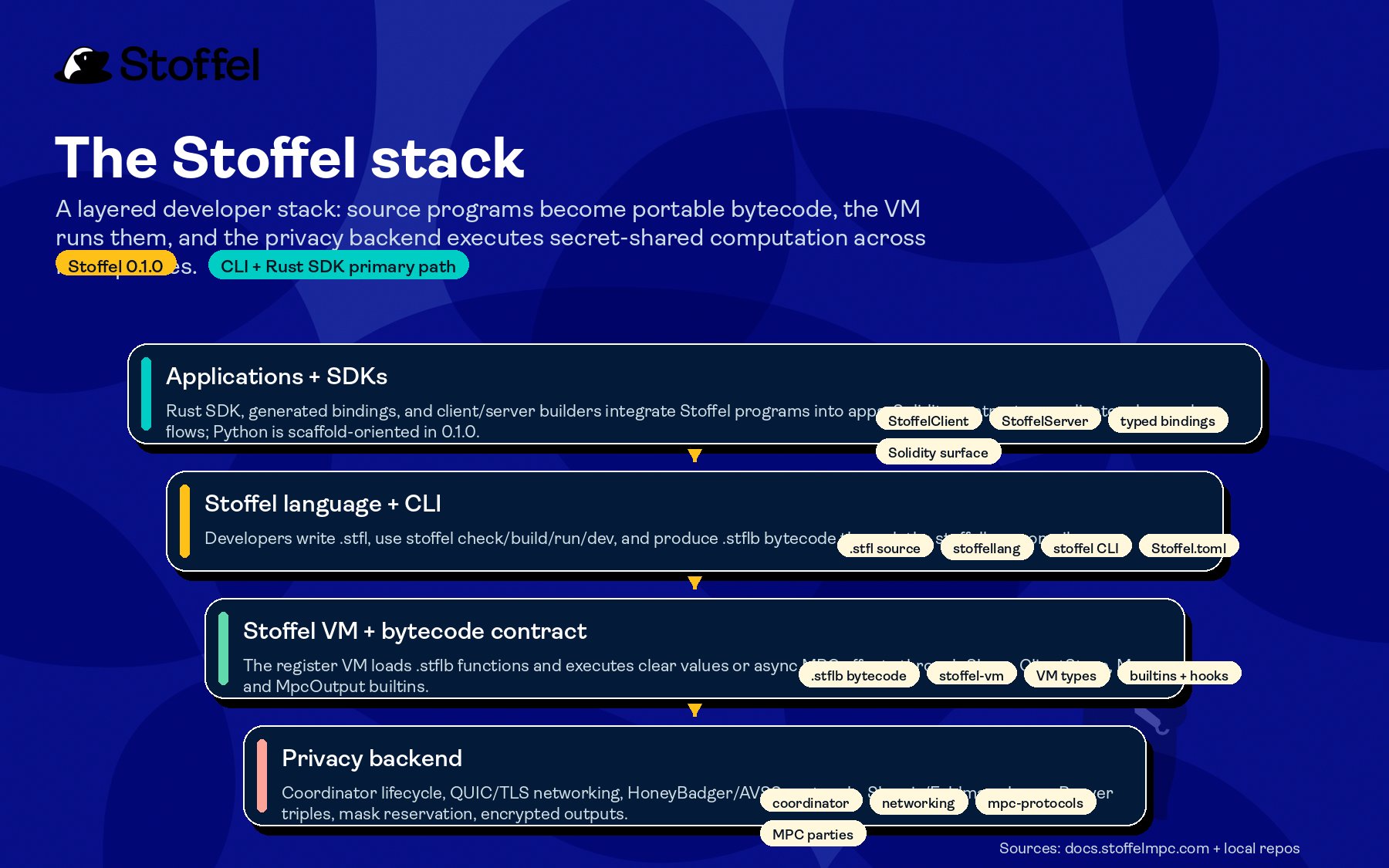 ## Technical Overview
### [Virtual Machine Architecture](./subsections/virtualmachine)
* What type of VM is stoffel
* Clear vs Secret values
### [Instruction Set](./subsections/instructionset)
* Complete reference of supported VM instructions
* Opcode specifications and behavior
* Optimization opportunities
### [Builtin Types](./subsections/builtintypes)
* Overview of core data types (numbers, strings, arrays, etc.)
* Type conversion and manipulation
* Memory representation and optimization
### [Activation Records](./subsections/activationrecords)
* Call stack management and function invocation
* Local variable scoping and lifetime
* Optimizing stack frame allocation
### [VM Functions](./subsections/vmfunctions)
* Virtual machine architecture overview
* Execution model and stack management
* Error handling
### [Closures Overview](./subsections/closures)
* Lexical scoping and variable capture
* Implementation details and memory management
### [Foreign Function Interface](./subsections/foreignfunctioninterface)
* Integrating with external libraries and systems
* Data marshalling and type conversion
* Performance considerations for FFI calls
### [Builtin Methods](./subsections/builtinmethods)
* Standard library functions and utilities
* Common operations for each data type
### [Runtime Hooks](./subsections/runtimehooks)
* Extension points for monitoring and customization
* Performance profiling and instrumentation
* Debugging facilities
## Why a Register Machine?
The choice of a register-based architecture over a stack-based design was driven by several key factors:
1. **Parallelization Opportunities**
* Register machines allow for easier identification of independent instructions
* Multiple instructions can be executed in parallel, reducing overall execution time
* Better suited for modern hardware architectures
2. **Communication Efficiency**
* Reduced number of memory access operations
* Fewer rounds of communication in Multi-Party Computation (MPC) contexts
* More efficient instruction encoding
3. **Optimization Potential**
* Direct access to operands enables better optimization strategies
* Easier to implement specialized instructions
* More straightforward analysis of data flow
## Why dedicated clear and secret registers
1. **Implicit reveal and hide**
* Having dedicated registers for secret and clear values allows us to implicitly reveal and hide values as they're moved between registers.
* Separation of registers allows for optimizations to be applied specifically to clear or secret operations.
* Avoids having to track the type of the virtual register during runtime as values may become secret shared or reveal through the course of execution.
## Technical Overview
### [Virtual Machine Architecture](./subsections/virtualmachine)
* What type of VM is stoffel
* Clear vs Secret values
### [Instruction Set](./subsections/instructionset)
* Complete reference of supported VM instructions
* Opcode specifications and behavior
* Optimization opportunities
### [Builtin Types](./subsections/builtintypes)
* Overview of core data types (numbers, strings, arrays, etc.)
* Type conversion and manipulation
* Memory representation and optimization
### [Activation Records](./subsections/activationrecords)
* Call stack management and function invocation
* Local variable scoping and lifetime
* Optimizing stack frame allocation
### [VM Functions](./subsections/vmfunctions)
* Virtual machine architecture overview
* Execution model and stack management
* Error handling
### [Closures Overview](./subsections/closures)
* Lexical scoping and variable capture
* Implementation details and memory management
### [Foreign Function Interface](./subsections/foreignfunctioninterface)
* Integrating with external libraries and systems
* Data marshalling and type conversion
* Performance considerations for FFI calls
### [Builtin Methods](./subsections/builtinmethods)
* Standard library functions and utilities
* Common operations for each data type
### [Runtime Hooks](./subsections/runtimehooks)
* Extension points for monitoring and customization
* Performance profiling and instrumentation
* Debugging facilities
## Why a Register Machine?
The choice of a register-based architecture over a stack-based design was driven by several key factors:
1. **Parallelization Opportunities**
* Register machines allow for easier identification of independent instructions
* Multiple instructions can be executed in parallel, reducing overall execution time
* Better suited for modern hardware architectures
2. **Communication Efficiency**
* Reduced number of memory access operations
* Fewer rounds of communication in Multi-Party Computation (MPC) contexts
* More efficient instruction encoding
3. **Optimization Potential**
* Direct access to operands enables better optimization strategies
* Easier to implement specialized instructions
* More straightforward analysis of data flow
## Why dedicated clear and secret registers
1. **Implicit reveal and hide**
* Having dedicated registers for secret and clear values allows us to implicitly reveal and hide values as they're moved between registers.
* Separation of registers allows for optimizations to be applied specifically to clear or secret operations.
* Avoids having to track the type of the virtual register during runtime as values may become secret shared or reveal through the course of execution.