Introduction

Stoffel 0.1.0 docsThese docs track the Stoffel 0.1.0 release. Use component pages for current API, security, and deployment status.

What Stoffel is

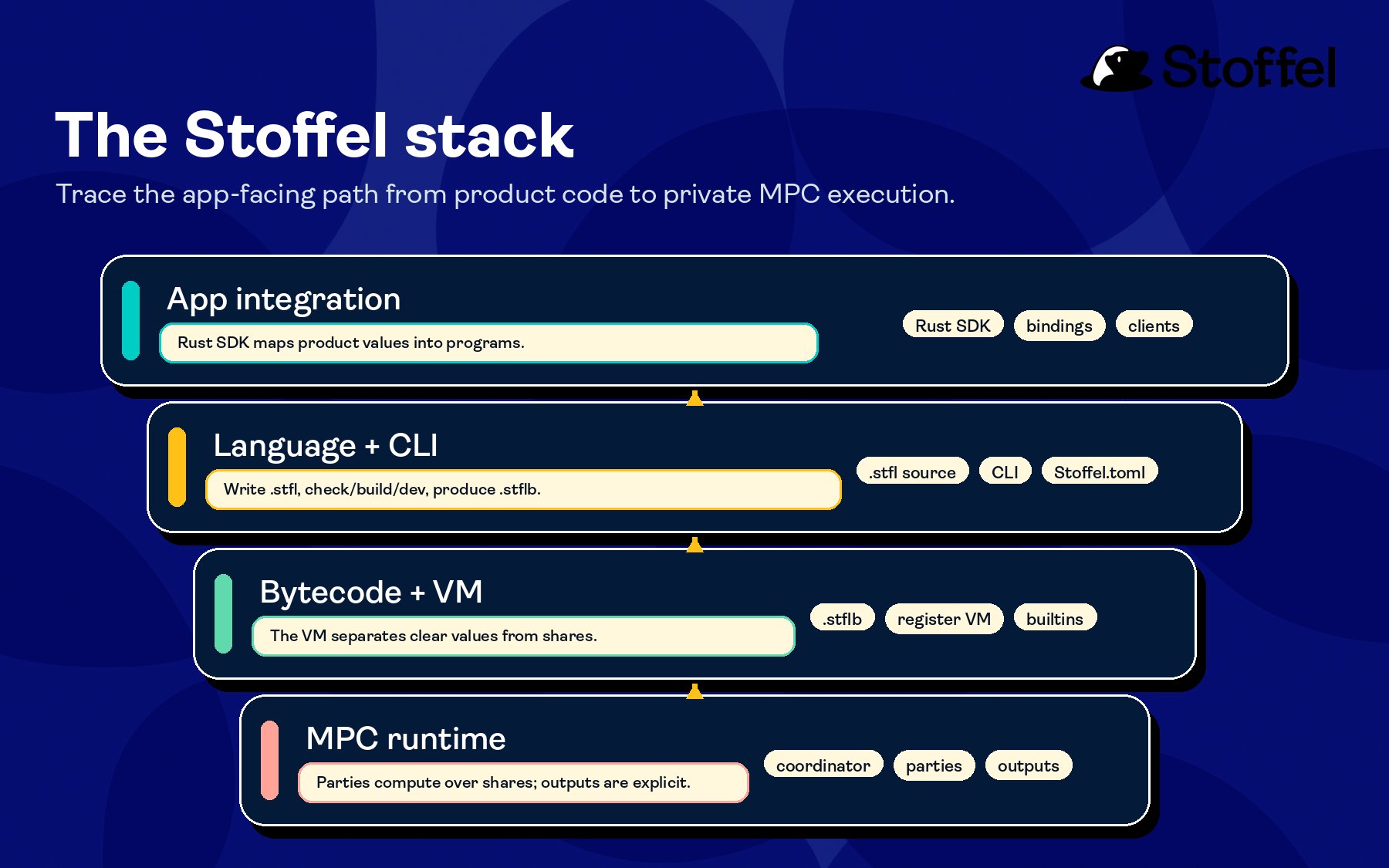
Stoffel is a developer stack for secure multiparty computation (MPC). It gives application developers a practical way to write programs that operate on secret-shared data, test them locally, and integrate them through familiar CLI and Rust SDK workflows. Most software privacy has a missing layer: we encrypt data at rest, encrypt data in transit, and then decrypt it to compute. MPC addresses that data-in-use gap by letting multiple parties jointly compute over shares of private inputs. Stoffel packages that model into developer tooling: a language, compiler, VM, local runner, and SDK surface that let you focus on the application logic instead of implementing MPC protocols from scratch.

What is in 0.1.0

The 0.1.0 release ships the core developer workflow from Stoffel-Labs/stoffel:
ComponentCrate/package0.1.0 status
Stoffel CLIcrates/stoffel-cli / binary stoffelCargo-like project CLI for init, check, compile, build, run, dev, test, status, clean, and update.
Stoffel Lang compilercrates/stoffel-lang / crate stoffellangPython-style language compiler that emits Stoffel VM bytecode.
Rust SDKcrates/stoffel-rust-sdk / library crate stoffelPrimary application API for compile/load/run workflows, local clear execution, local MPC simulation, network configuration, observability, and on-chain coordinator handles.
Stoffel VMcrates/stoffel-vmRegister-based VM runtime with builtins, secret-share values, networking/MPC integrations, C FFI, and the stoffel-run helper binary.
VM types and bytecodecrates/stoffel-vm-typesShared value, instruction, function, and compiled .stflb bytecode types.
Start from the stoffel repository for the Stoffel 0.1.0 workflow.

What you can do today

  • Write computations in Stoffel Lang with explicit secret values.
  • Use clear local execution for fast logic checks.
  • Use the Rust SDK as the primary app integration path.
  • Run local MPC-style smoke tests with the SDK or CLI and stoffel-run.
  • Generate, save, load, inspect, and execute .stflb bytecode.
  • Create project templates for Stoffel, Rust, Python, Foundry, and Hardhat workflows.

How to think about 0.1.0

These docs describe the Stoffel 0.1.0 release. The Rust SDK and CLI are the documented application path for building, testing, and deploying Stoffel applications. Other SDK and on-chain surfaces are present for exploration and integration planning. MPC is a powerful primitive, not a complete security product by itself. Deployment teams should validate component status, threat models, output design, metadata exposure, operational hardening, and application-level access control for their use case.

Security review and deployment

mpc-protocols has received an external audit from Zellic. Other parts of the codebase have had AI-assisted security review, including tools such as veria.dev. Treat this coverage as component-scoped: deployment teams should validate the full application, integration code, configuration, and threat model they rely on.

Start here

  1. Install Stoffel 0.1.0
  2. Run the 0.1.0 quick start
  3. Explore the current ecosystem map
  4. Use the Rust SDK